
Santorini food: understand the ingredients behind the menu
Santorini’s food is closely connected with the island’s dry landscape, local crops and village traditions. A useful way to explore it is to begin with a few ingredients—fava, small tomatoes, white aubergine and wine—then ask how a kitchen prepares them. You do not need to order every speciality at one meal. Leave room to notice what is seasonal, what is made in-house and what your group actually enjoys.
On this page
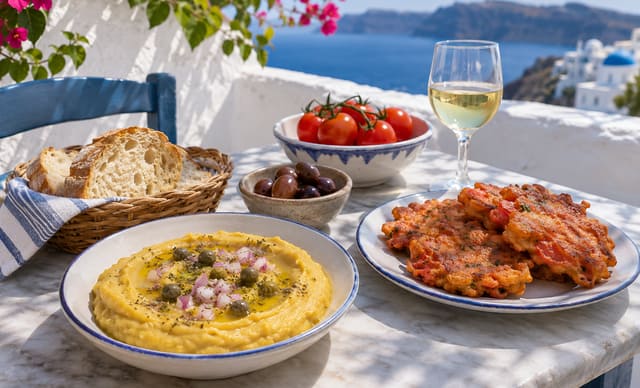
Start with the island’s ingredients
The dry volcanic setting is part of the food story, but it should not turn every menu item into an automatic claim of local origin. A restaurant can serve a dish associated with Santorini without every ingredient having been grown on the island. If provenance matters to you, ask a straightforward question about the product being used.
Protected names are also more specific than a general culinary style. Santorini fava and Santorini tomatoes have protected local identities described by the municipality. That does not mean every bowl of fava or every tomato salad anywhere on the island is made from a protected-origin product. Think of the name as a useful starting point for a conversation, not a substitute for one.
| Name to recognise | What it refers to | A useful question |
|---|---|---|
| Fava | A legume puree; Santorini’s protected product uses Lathyrus clymenum | Is this made with Santorini fava? |
| Tomatokeftedes | Tomato fritters | What is in this version and what is served with it? |
| White aubergine | A local crop used in several preparations | How is it cooked today? |
| Chloro | A fresh goat cheese made in limited quantities | Is it available, and how is it served? |
| Melitinia | Small hand-shaped cheese-filled sweets | Are these made here, and what is the filling? |
Fava: a simple dish with a specific identity
Fava is often an accessible first dish for understanding Santorini’s ingredients. The local protected product comes from Lathyrus clymenum. In menu terms, expect a legume-based preparation rather than broad beans; the misleading English association with “fava beans” can otherwise create confusion before the food arrives.
Pay attention to the way a kitchen finishes it. Toppings and accompaniments can change how the dish works with the rest of a meal. Ask what comes with it, especially if you plan to share several starters. Do not use its plant-based main ingredient to infer that every restaurant version meets a particular dietary requirement.
Tomatoes, white aubergine and chloro
Tomato fritters are one of the island’s familiar preparations, while small tomatoes also appear in other dishes. The interesting question is not whether you have ticked the speciality off a list but how that kitchen uses the ingredient. A crisp fritter, a salad and a cooked dish offer different experiences, so choose a combination rather than three versions of the same role at the table.
White aubergine gives you another ingredient to investigate, in dishes whose preparation may vary from place to place. Chloro is a fresh goat cheese associated with the island and made in limited quantities. Availability should be checked, not promised. If a dish depends on a product that is unavailable, ask for the kitchen’s alternative rather than assuming a substitution is the same local speciality.
Build a meal you can enjoy
Sharing several plates can be a good way to try unfamiliar food, provided the group agrees on the ingredients and pace. Start with a manageable order and ask about portion size before adding more. A small party does not need one of every local dish to have an interesting meal.
Balance your food plans with the rest of the day. A long lunch belongs naturally in a relaxed village or beach outing; it may be less comfortable immediately before a fixed transfer or a substantial walk. If there is a particular dinner view you want, confirm the seating arrangements and what the reservation actually guarantees. A village name or a photograph of a terrace does not identify your table.
- Ask which dishes are available that day rather than treating an online menu as a promise.
- Check whether a price refers to a portion, a plate for sharing or another basis.
- State dietary requirements clearly and ask the kitchen to confirm ingredients and preparation.
- Treat a special view and the food itself as separate parts of the choice.
Leave room for the sweet traditions
The municipality links melitinia with Easter: small sweets with soft cheese inside carefully shaped dough. Koufeto, made with almonds and honey, is associated with weddings. These connections are part of the island’s food culture, even when versions are available beyond the original occasion.
If you buy food to take home, ask how it should be stored and transported. A fresh preparation and a packaged product may need very different treatment. For a gift, retain the ingredient and producer information rather than relying on a description remembered from a shop conversation.
Let the wine tell another part of the story
Assyrtiko is central to Santorini’s white-wine identity, while the island’s traditional low, coiled vines help explain why vineyards do not look like the familiar rows of tall trellises seen elsewhere. A tasting can add context, but you can also begin by asking a restaurant to explain a local glass or bottle that suits your preferences.
Vinsanto introduces another style, associated with sun-dried grapes. Do not assume every wine produced on the island is the same kind or carries the same protected designation. Compare the producer, grape and style, and arrange transport around any tasting activity. A useful introduction should leave you with an understanding of what you tasted, not just a list of labels.
Choose food experiences with clear expectations
A cooking session, tasting and restaurant meal serve different purposes. Ask whether the experience is practical or demonstrative, what is included, how large the group is and whether your dietary needs can be accommodated. “Local” and “traditional” are broad descriptions; concrete details make the choice reviewable.
This introduction combines local experience with additional research into dishes and ingredients. Use the restaurant and winery pages to investigate practical arrangements, and verify current opening and availability directly before making a trip specifically for one meal or product.
Common questions
- What should I try first in Santorini?
- Fava, a tomato-based dish and a white-aubergine preparation make useful starting points. Ask how they are prepared and order to suit your group rather than treating every speciality as compulsory.
- Is Santorini fava made from broad beans?
- The protected Santorini product uses Lathyrus clymenum, a different legume. A broad-bean translation can be misleading.
- Are tomato fritters suitable for a particular diet?
- Recipes and kitchen practices vary. Ask the venue about ingredients, allergens and preparation; the dish name alone is not enough.
- What is melitinia?
- Melitinia are small cheese-filled sweets with carefully shaped dough, associated with Santorini’s Easter tradition. Ask about the filling and availability where you buy them.