Santorini volcano: understand the landscape and the visit
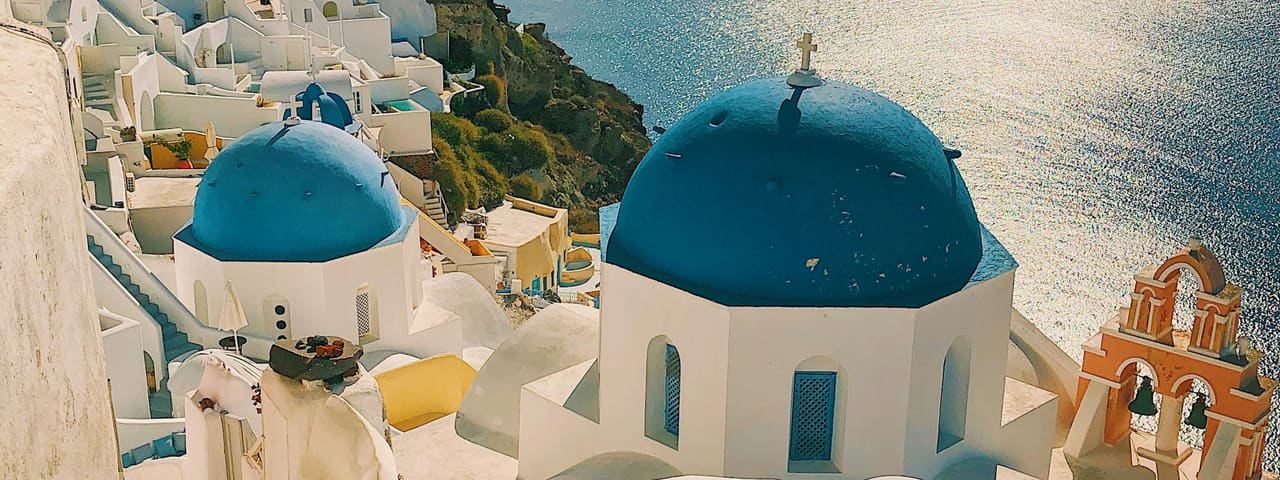
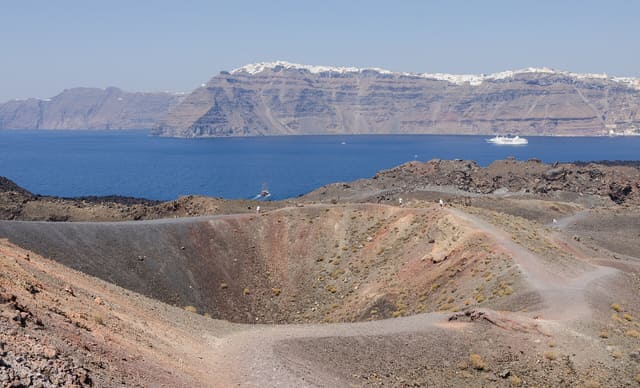
Santorini’s caldera is the large volcanic setting behind the island’s famous cliff views. Within it, Nea Kameni and Palea Kameni form part of the volcanic-island landscape. A view from a village, a cruise through the caldera and a landing for a walk are different ways of experiencing it. Choose according to your interests and the practical details of the actual trip.
On this page
The caldera and the volcanic islands
GNTO describes an island group shaped by repeated volcanic episodes. The caldera view is therefore a landscape with several parts, rather than one crater you can reach by driving to a viewpoint. It helps to identify the main island, Thirasia and the volcanic islets on a map before choosing an excursion.
The municipality describes Nea Kameni as a place visited by boat with a walking route on the volcanic terrain. That is different from simply staying on a vessel to appreciate the cliffs and sea. Think about whether you want geological interpretation, time on foot, photography from the water or a relaxed excursion; the best match depends on which of those matters most.
Read the programme rather than the excursion name
Tour names can be broad. Ask for the actual departure point, the proposed stops, whether you leave the boat, and what happens if a landing is unavailable. Establish whether any admission or transfer is included. A programme that visits Thirasia is not automatically equivalent to one focused on the volcanic islets.
Check the final return as carefully as the beginning. Your accommodation may be some distance from the harbour, and a transport arrangement advertised for one village may not cover another address. Avoid booking an excursion between tightly timed arrival and departure commitments unless the complete plan has been confirmed.
- Which harbour and exact meeting point does the trip use?
- Does the programme include a landing and, if so, where?
- How much walking is expected, over what surface and at what pace?
- What changes if weather, authority restrictions or conditions prevent a stop?
- When and where does the return transfer finish?
Choose a visit that suits your group
A boat excursion may combine vehicle access, steps onto a vessel, a landing and walking on uneven ground. Ask about each stage separately if you have specific mobility needs or are travelling with children. A general label such as “suitable for everyone” is less useful than an explanation of the route and the help available.
If your group has mixed interests, a scenic trip with a clear programme may suit some people better than a walk. Equally, visitors interested in geology may want interpretation rather than a series of short photo stops. Agree on expectations before booking and check whether everybody needs to take part in every activity.
Keep geological history separate from current status
Santorini’s volcanic history is complex, and a short travel guide should not present a fixed eruption cycle, an exact future prediction or a broad assurance of safety. Official tourism sources themselves use simplified language. This guide follows GNTO’s description of an active volcanic complex and keeps visitor logistics separate from scientific monitoring.
For a current restriction or disruption, consult the responsible authorities and the operator rather than relying on an old itinerary. The same principle applies to coastal stops: an excursion passing a named beach does not establish permission to land or swim in a restricted area. Build flexibility into the day and keep the focus on the experience actually available.
Common questions
- Can I drive to the volcanic islets?
- Nea Kameni and Palea Kameni are islands in the caldera. Visits involving them are boat-based; a road journey to a Santorini village is a different experience.
- Does every caldera cruise include the volcano walk?
- No. Read the individual programme and confirm landings, walking demands, inclusions and return arrangements.
- Is the volcano inactive?
- GNTO describes Santorini as an active volcanic complex. Visitor information should not be interpreted as a scientific activity forecast or a guarantee of unrestricted access.